INTAQT Holds Executive Committee Meeting in Paris
On 24 February 2026, the INTAQT Consortium held an extended Executive Committee (ExCom) meeting in… Read more »
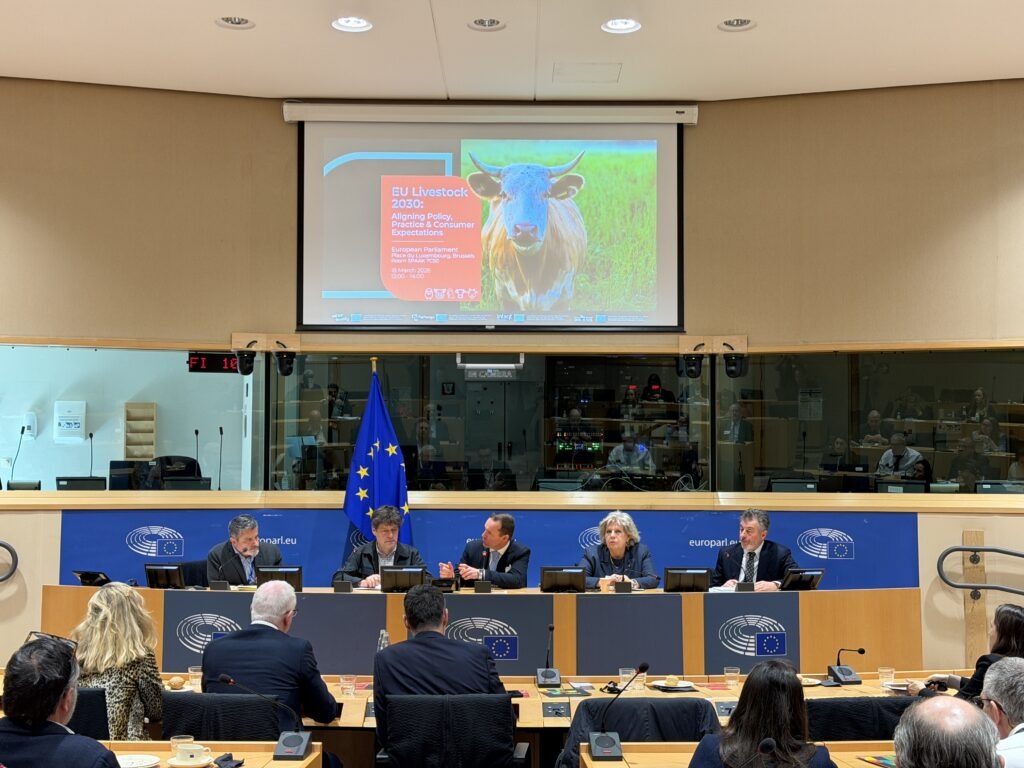
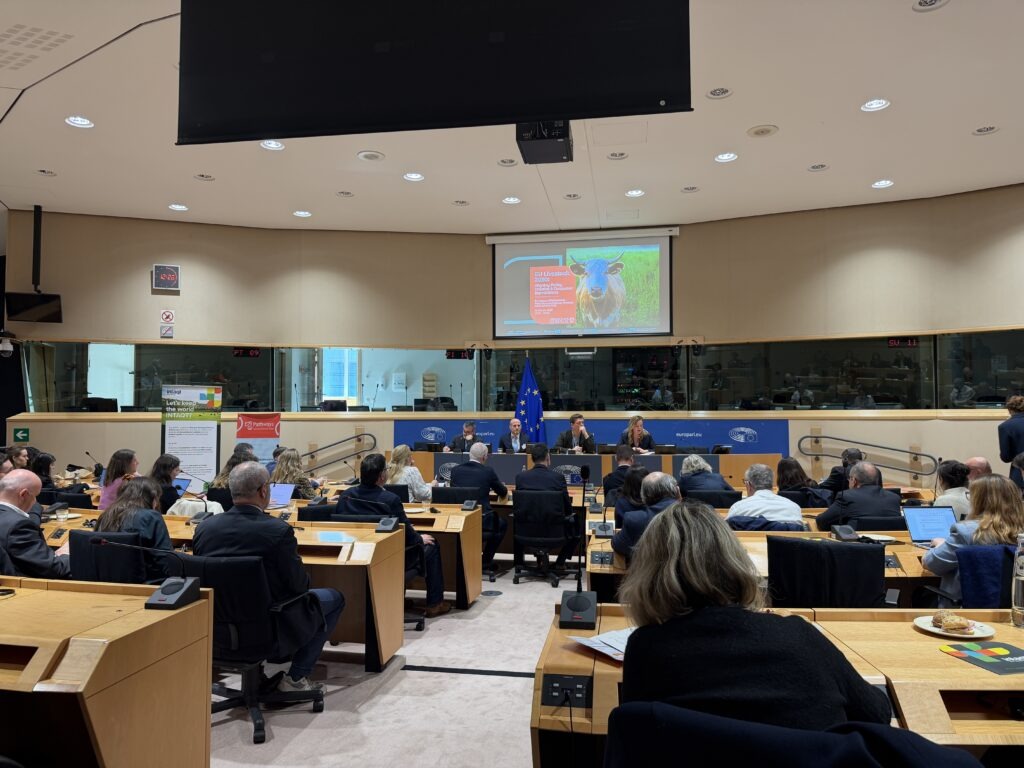
On 18 March 2026, the four EU-funded sister projects INTAQT, PATHWAYS, mEATquality and Code: Re-farm, convened at the European Parliament – an event kindly hosted by MEP Benoit Cassart. The gathering brought together policymakers, researchers and food-chain stakeholders to reflect on how Europe can steer its livestock systems towards 2030. Key themes included product authenticity and quality, consumer expectations and economic sustainability, in line with the evolving EU agricultural policy framework.
The event opened with Alisa Tiganj (Cabinet of the Commissioner for Agriculture and Food), who outlined the upcoming EU livestock strategy. She emphasised that one-size-fits-all solutions are not appropriate for a sector as diverse as European livestock, and that the strategy has been developed through a bottom-up approach involving a range of stakeholders.
The strategy is built around four pillars:
Tiganj noted that the livestock strategy will not stand alone, but will support other EU initiatives, including the generational renewal strategy.
Laurence Smith, PATHWAYS Coordinator, presented the four EU-funded sister projects highlighting their combined contribution to the transition towards more sustainable and reliable livestock farming models in the EU. Key remarks:
Common themes across all four projects include quality and authenticity, sustainable systems, consumer trust, and evidence-based policy support.
Bruno Martin, from INTAQT project, focused his presentation on the authenticity of meat of animal origin, drawing on analyses carried out by mEATquality and INTAQT projects. He explained that production and processing techniques, together with environmental conditions, determine specific characteristics that give the product its identity and added value. In this context, he emphasised the need for commercial claims to accurately reflect these qualities, as a safeguard against food fraud and to protect the integrity of European agri-food chains.
Klaus Grünert, from mEATquality, presented a summary of PATHWAYS, INTAQT and mEATquality conclusions, placing particular emphasis on the role of the consumer as a driving force in the green transition. He highlighted that consumers’ purchasing decisions can either accelerate or slow down this transition, making them a decisive factor. He also added that behaviour is influenced by factors such as willingness to pay a higher price, the ability to recognise sustainable products, and their availability on the market.
The key findings of this overview included:
Jorge Campos González, from PATHWAYS, addressed the economic aspects of livestock production, emphasising that the transition to sustainable livestock farming requires a three-way balance: environmental performance, economic viability for farmers, and social acceptance by consumers. He stressed that change will only be possible if it is profitable and builds trust in the system.
mEATquality results show that profitability is only one part of resilience. Extensive systems often build value-based resilience through product quality and territorial identity, while intensive systems rely on scale-based resilience through integration and bargaining power. Policy should support both – but in different ways.
In this regard, the PATHWAYS project suggests that innovations can be economically viable and that competitiveness is generally positive, and not simply a function of farm size. Meanwhile, work from INTAQT on intensification in poultry showed trade-offs between yield gains and quality losses, illustrating the complexity of these decisions.
Code: Re-farm findings reminded the audience that there is no single road to sustainability – rather, a landscape of diverse transformation pathways. Some farms improve what already works through familiar upgrades and greater transparency. Others innovate within the existing system, creating new welfare-oriented models that add value and open fresh revenue opportunities. A third group reshapes how the entire ecosystem is organized – strengthening local-for-local chains, circularity, and cooperation to scale solutions and reduce costs. And then there are the pioneers who move into full transformation, co-creating new partnerships, sharing monitoring tools, and building the foundations of future competitiveness. Together, these pathways form a rich map of how change can happen – not all at once, and not in the same way for everyone.
The panel opened with live audience responses via Mentimeter, which showed that sustainability was the dominant concept participants associated with the future of livestock.
Paolo Patruno from CLITRAVI emphasised that while consumers say they want to buy local and sustainable products, their actual choices are largely price-driven – particularly during times of economic pressure. He called for a more competitive and pragmatic approach to shaping the livestock strategy.
Simona Caselli from COPA COGECA agreed on the price sensitivity point and raised concerns about the complexity of EU origin labelling. She noted that even the most well-known EU quality mark – the organic label – is only recognised by around 30–35% of consumers, while other labels struggle to reach 15% awareness. She stressed that consumers’ ability to understand and choose products is fundamental, and shared that in her cooperative, origin and transparency are central to the entire value chain. She also cautioned against overproduction, noting that “we’re producing more than we can afford.”
Andrea Gavinelli from Animal Welfare SANTE.G.3, argued that competitiveness should not be reduced to price alone. He framed authenticity as a genuine market opportunity for Europe and stressed that defending EU standards against non-EU imports requires building trust – through research, investment, and getting ahead of the competition.
Bruno Martin from INRAE reiterated the importance of a holistic methodological approach, acknowledging that integrating all dimensions of sustainability is methodologically complex but necessary.
MEP Benoit Cassart drew together several key threads from the event:
This final event served as a strong reminder of the value of EU funded research: bringing stakeholders together, generating robust knowledge, and contributing to solutions for a more sustainable and trustworthy food system.
We extend our sincere appreciation to our sister projects – PATHWAYS, mEATquality and Code:Re-farm – and to all participants whose engagement and contributions made the event both meaningful and memorable.
On 24 February 2026, the INTAQT Consortium held an extended Executive Committee (ExCom) meeting in… Read more »
Scientific topics closely aligned with the INTAQT project have recently been presented to a wide… Read more »
On 6 March 2025, John Albechaalany successfully defended his doctoral thesis in Clermont-Ferrand, surrounded by… Read more »