INTAQT Final Conference Showcases Research Results on Sustainable, High-Quality Livestock Production
Hamburg, Germany, 11 September 2026 After five years of collaborative European research into the future… Read more »

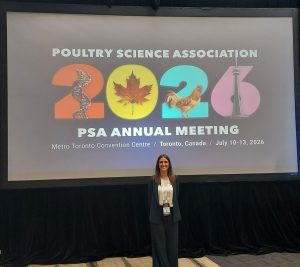
On July 11, 2026, Martina Bordini, post-doctoral researcher in the Department of Agricultural and Food Sciences of the Alma Mater Studiorum – University of Bologna, has been invited to give a presentation entitled “Omics technologies in poultry meat quality: Advancements in the molecular basis of breast fillets myopathies”, as part of the Symposium “Poultry Meat – Global Quality Issues” organized during the Poultry Science Association Annual Meeting (PSA 2026).
Reflecting the goals of the INTAQT project, the presentation provided an overview of the major omics technologies currently applied in poultry meat research and highlighted their contribution to the understanding of growth-related breast muscle myopathies in broiler chickens.
The talk explored how advances in genomics, transcriptomics, proteomics, and metabolomics have transformed life sciences research over the last two decades, enabling the simultaneous analysis of thousands of biological molecules and generating unprecedented insights into complex biological traits. In poultry science, these technologies are increasingly used to investigate the molecular mechanisms underlying complex traits, such as productive performance and meat quality.
Particular attention was dedicated to the application of omics approaches to growth-related breast fillet myopathies, including White Striping (WS), Wooden Breast (WB), and Spaghetti Meat (SM). Research conducted over the past 10 years has revealed that these conditions are associated with profound alterations in muscle metabolism, oxidative balance, calcium homeostasis, tissue repair mechanisms, and protein turnover. Through the integration of genomic, transcriptomic, proteomic, and metabolomic data, scientists have progressively uncovered the molecular hallmarks characterizing affected muscles and their underlying biological pathways.
The presentation also highlighted recent research carried out at the University of Bologna, including integrated transcriptomic analyses investigating the regulatory role of microRNAs in Wooden Breast myopathy and comparative proteomic studies aimed at identifying common and condition-specific molecular signatures among growth-related breast muscle abnormalities. These findings contribute to a more comprehensive understanding of the biological mechanisms involved in the onset and progression of these economically important defects.
Looking ahead, emerging technologies such as spatial transcriptomics and spatial proteomics, together with the growing integration of multi-omics datasets and artificial intelligence tools, are expected to further accelerate discoveries in poultry meat science. These approaches offer new opportunities to characterize tissue organization, identify novel biomarkers, and support the development of holistic strategies for improving poultry health, production efficiency, and meat quality.
The presentation provided an opportunity to discuss the growing role of omics sciences in addressing complex meat quality challenges and emphasized the importance of interdisciplinary collaborations for translating large-scale biological data into meaningful knowledge and practical applications for the poultry sector.


Hamburg, Germany, 11 September 2026 After five years of collaborative European research into the future… Read more »
On 9 September 2026, the INTAQT project presented its latest research findings during a dedicated… Read more »
On July 16, 2026, Prof. Massimiliano Petracci from the Department of Agricultural and Food Sciences… Read more »